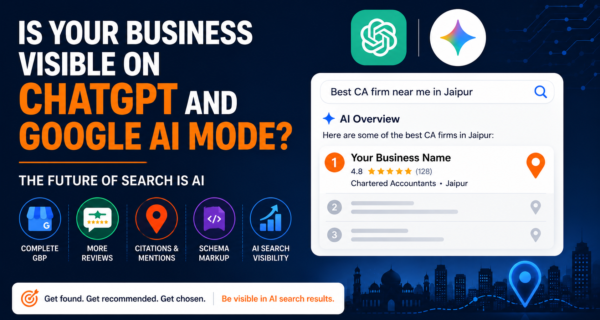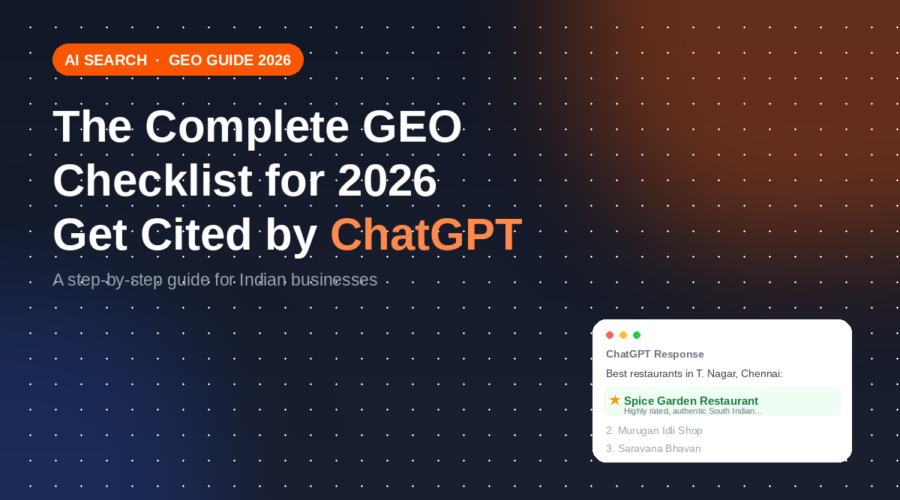
When someone in Chennai asks ChatGPT “best restaurants in T. Nagar” or asks Google’s AI Overview “top dentists near Koregaon Park,” an AI model generates a direct answer — typically naming 2–4 specific businesses. There’s no scrolling, no comparing ten blue links. The customer gets a name, and if your business isn’t the name, you don’t exist in that moment.
This is already happening at scale. ChatGPT has passed 180 million weekly users worldwide, Google’s AI Overviews are rolling out steadily across Indian search results, and Perplexity has become a default research tool for a growing share of urban Indian consumers. None of this is “coming soon” — it’s live, today, and almost entirely uncontested by local Indian businesses.
We covered the awareness side of this shift in an earlier post — Is Your Business Visible on ChatGPT and Google AI Mode? — if you haven’t confirmed your own visibility yet, start there. This post is the tactical follow-up: the exact checklist to fix it.
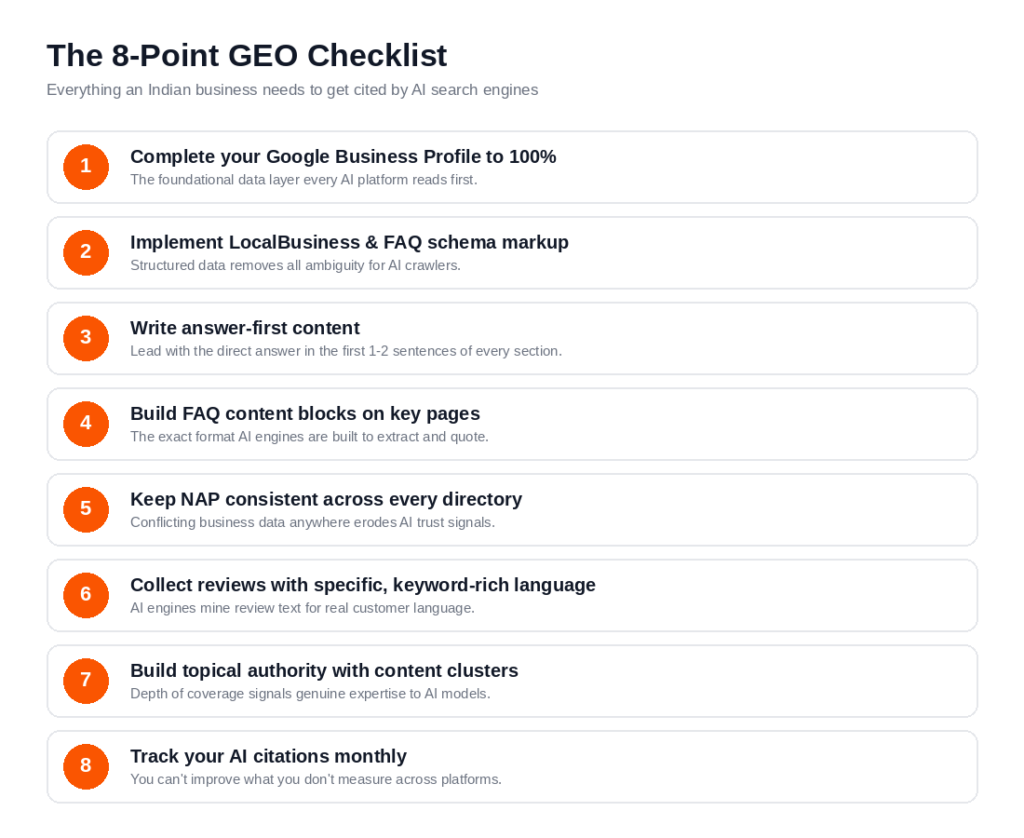
The 8-Point GEO Checklist
These eight actions cover everything an Indian local business needs to become citation-worthy across every major AI platform. Work through them in order — each one builds on the last.
1. Complete Your Google Business Profile to 100%
Every AI platform — including ChatGPT, which increasingly pulls from Google’s local data via browsing — treats your GBP as the single most trusted source of truth about your business. A profile with gaps in hours, categories, services or photos gives AI models less to work with and less confidence to cite you. This is table stakes, not optional. Our GBP Management service handles this end-to-end if you’d rather not do it manually.
2. Implement LocalBusiness and FAQ Schema Markup
Schema markup is structured code that explicitly labels your business data for machines — this is the name, this is the address, this is a frequently asked question and its answer. AI crawlers rely heavily on this structured layer because it removes ambiguity that plain text leaves open to misinterpretation. A business with clean schema is dramatically easier for an AI model to cite accurately than one without it. We go deep on exactly which schema types matter in our Schema Markup & Structured Data guide.
3. Write Answer-First Content
AI engines extract text the same way a time-pressed human skims — they weight the first sentence or two of every section most heavily. If your website’s content buries the actual answer under three paragraphs of preamble, you’re making it structurally harder to be quoted. Lead with the direct answer, then explain.
4. Build FAQ Content Blocks on Every Key Page
Question-and-answer formatted content is, almost literally, the exact shape AI engines are built to extract. A clearly labeled question followed by a concise, direct answer is far more citation-friendly than the same information buried in narrative paragraphs.
5. Keep NAP Consistent Across Every Directory
Name, Address, Phone (NAP) inconsistency across JustDial, IndiaMart, Facebook and your own website actively erodes AI confidence in your business data. If your address is formatted three different ways across the internet, an AI model has no reliable way to know which one is correct — and the safe move for it is to simply not cite you.
6. Collect Reviews With Specific, Keyword-Rich Language
AI engines mine review text for real customer language — “best dentist for root canal in Koregaon Park” is far more useful to an AI model than a bare five-star rating with no text. Encourage customers to be specific when they leave reviews, not just complimentary.
7. Build Topical Authority With Content Clusters
A single blog post about your category doesn’t establish authority. A structured cluster of content covering every angle of your service — pricing, process, comparisons, FAQs, case studies — signals genuine depth of expertise, which is precisely what AI models are trying to identify before they recommend a source.
8. Track Your AI Citations Monthly
You cannot improve a visibility channel you aren’t measuring. Run the same set of queries against ChatGPT, Perplexity, Gemini and Google AI Mode every month, and track whether and how your business appears. This is exactly what our AI & GEO Content service does for clients as a standing monthly process.
Real Results: From Zero AI Visibility to 14 Monthly Citations
Spice Garden Restaurant in T. Nagar, Chennai, had strong Google Maps rankings but didn’t exist anywhere in AI search — asking ChatGPT for restaurant recommendations in their area never surfaced them, despite years of great reviews. Here’s what changed after 90 days of GEO-optimized content:
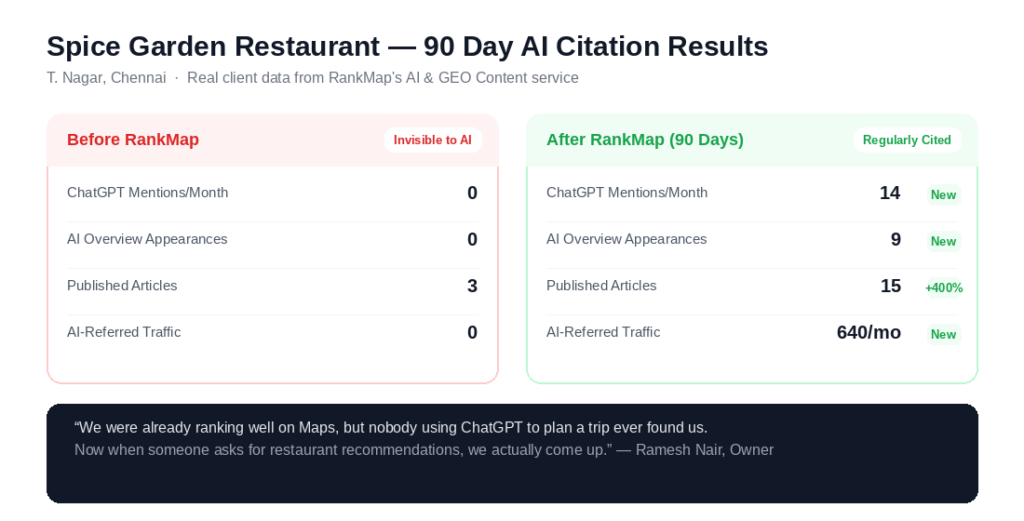
Zero ChatGPT mentions became 14 a month. Zero AI Overview appearances became 9. And critically, this happened without any change to their already-strong Google Maps ranking — GEO is additive, not a replacement for the fundamentals.
How RankMap Handles This For You
Doing all eight steps manually, every month, across four AI platforms, is realistically a part-time job on top of running your actual business. RankMap’s AI stack automates the entire loop:
- AI & GEO Content Optimization — answer-first blog content, FAQ blocks, and citation-worthy data published on a monthly calendar, tracked against real AI citation results.
- Schema Markup & Structured Data — every schema type your business needs, implemented and validated, so AI engines have zero ambiguity about who you are.
- AI SEO — the entity and profile-level signals (beyond content) that determine whether ChatGPT, Gemini and Google AI Mode trust and recommend your business at all.
See more real client results, including Spice Garden’s full case study, on our Success Stories page.
Frequently Asked Questions
What’s the actual difference between SEO and GEO?
Traditional SEO optimizes for ranking position in a list of search results. GEO optimizes for being the specific answer an AI model gives when it doesn’t show a list at all — just a direct, generated response. The underlying signals overlap significantly (schema, content quality, authority), but GEO specifically prioritizes answer-first formatting and citation-worthy structure.
How long does it take to get cited by ChatGPT?
Most RankMap clients see their first AI citations within 60 days of starting GEO-optimized content, with citation frequency compounding from there. Spice Garden Restaurant’s results above — 14 monthly ChatGPT mentions — were achieved in 90 days.
Do I need a developer to add schema markup?
No. Schema is code, but it’s implemented once and doesn’t require ongoing developer involvement unless your business details change frequently. RankMap’s Schema Markup service handles the audit, writing and validation without needing any technical involvement from you.
Which AI platform should I focus on first?
Start with Google AI Overviews, since it’s shown directly inside the search results Indian customers already use daily, giving it the highest overall reach. ChatGPT is the fastest-growing second priority, particularly for younger, urban audiences doing research-style queries.
Can a small local business really compete with big brands in AI search?
Often more easily than in traditional SEO. AI models weight specificity, structured data and genuine local relevance heavily — a well-optimized single-location business with clean schema and strong local reviews frequently outperforms a national chain with a generic, poorly-structured web presence for local, specific queries.
How do I know if my business is currently being cited anywhere?
Manually query ChatGPT, Perplexity and Google AI Mode with the searches your customers would realistically use — “best [your category] in [your city]” is the simplest starting point. For ongoing tracking without doing this by hand every month, RankMap’s AI & GEO Content service includes citation monitoring as a standard part of the plan.
Ready to Get Cited by AI Search?
Get a free content audit and see exactly where your AI visibility gaps are — before your competitors close them first.
Want results like these for your business?
RankMap's AI manages your GBP, reviews, and citations automatically — so you rank #1 on Google Maps without lifting a finger.