A restaurant owner in Bangalore once told us his food was better than the place ranking #1 near him — and he was probably right. But the #1 spot had 340 reviews with new ones arriving every week. He had 28 reviews, and the latest one was from Diwali last year.
Google didn’t rank the better restaurant. It ranked the better review profile.
In 2026, that’s not an unfair edge case — it’s exactly how the system works. Reviews are no longer just social proof; they’re one of the heaviest levers in Google’s local algorithm, they feed AI recommendations, and they decide whether customers even consider you. Here’s the data, and the exact playbook to fix it.
📋 Table of Contents
- Why Reviews Now Decide Your Google Maps Ranking
- The 2026 Review Data Every Business Owner Should See
- The Recency Trap: Why Old Reviews Stop Working
- How to Get More Google Reviews: The 6-Step Playbook
- Responding to Reviews (The Part Everyone Skips)
- What NOT to Do: Fake Reviews & Gating
- How RankMap Automates Your Entire Review Engine
- FAQ
Why Reviews Now Decide Your Google Maps Ranking
Let’s start with the number that changes how you think about reviews: according to 2026 local ranking factor analysis (based on Whitespark and BrightLocal research), review signals — quantity, velocity, diversity, and sentiment — make up roughly 16–20% of Google’s Local Pack algorithm. That’s one of the largest levers you directly control.
And the visibility gap is brutal: BrightLocal’s 2026 data shows businesses with 50+ Google reviews are 266% more likely to appear in the Local Pack than businesses with fewer than 10. As we covered in our post on “near me” search data, 42% of local searchers click one of those top 3 results — so this isn’t a vanity metric. It’s the doorway to nearly half your potential customers.
Reviews also now feed a second discovery layer: AI. With 45% of consumers using ChatGPT and similar tools for local recommendations, businesses with structured, active review profiles are the ones getting cited in AI answers. (More on winning that layer in our AI SEO service.)
The 2026 Review Data Every Business Owner Should See
BrightLocal’s Local Consumer Review Survey 2026 and other major studies this year paint a clear picture — consumer expectations have jumped sharply in just 12 months:
| The Stat | Why It Matters | Source |
|---|---|---|
| 97% | of consumers read reviews before choosing a local business. Review-reading is now universal behaviour. | BrightLocal |
| 41% | “always” read reviews before choosing — up from 29% just last year. The bar is rising fast. | BrightLocal LCRS 2026 |
| 31% | will only use a business rated 4.5★ or higher — nearly double last year’s 17%. | QuickFeedback |
| 266% | more likely to appear in the Local Pack with 50+ reviews vs. fewer than 10. | Searchlab / BrightLocal |
| 73% | only trust reviews written in the last month. Recency is now as important as volume. | Wiser Review |
| 88% | are likely to use a business that responds to all its reviews — vs. just 47% for businesses that don’t respond. | ReviewTrackers |
| +35% | more revenue for businesses that respond to at least 25% of their reviews. | Womply / ReviewTrackers |
| 44% | improvement in conversion likelihood from raising your average rating by one full star. | WiserNotify |
One more that surprises everyone: a perfect 5.0 rating is actually trusted less than 4.5 — Northwestern University’s Spiegel Research Center found consumers suspect fake reviews when the score is flawless. The sweet spot is 4.4–4.9 with visible, human responses. So stop panicking about the occasional 4-star review; it’s making you look real.
The Recency Trap: Why Old Reviews Stop Working
Here’s the pattern we see constantly with Indian businesses: a shop collects a burst of reviews when it opens (family, friends, early customers), reaches 40–60 reviews… and then stops asking. Two years later the owner wonders why a newer competitor with fewer total reviews is outranking them.
The data explains it. 73% of consumers only trust reviews written in the last month — and Google’s algorithm mirrors this bias, rewarding a steady inflow over a one-time burst. A business with 500 reviews whose latest is 8 months old has weaker social proof than a competitor with 50 reviews arriving weekly.
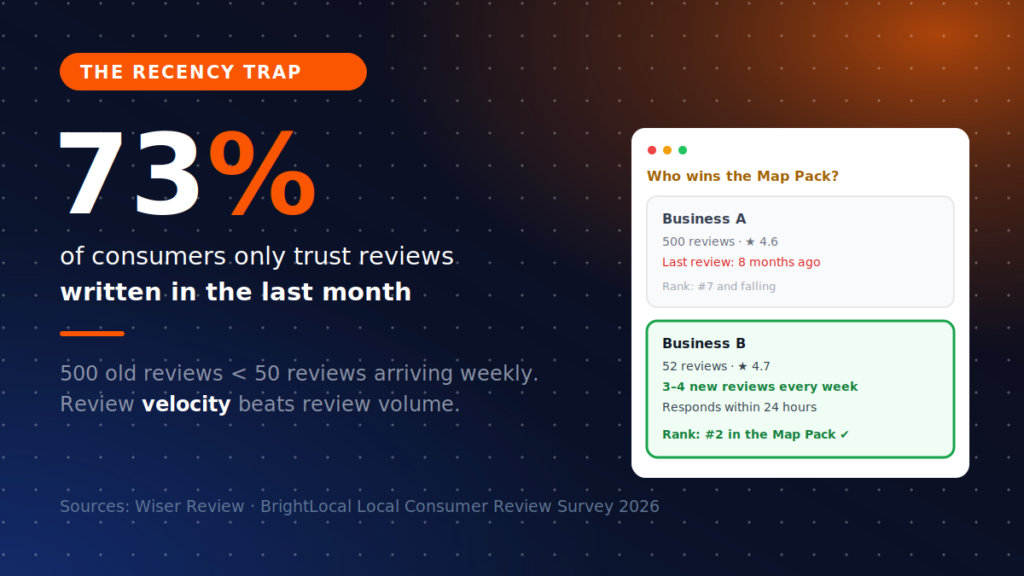
Think of reviews like a cricket player’s form: nobody cares about your career average if you haven’t scored runs in the last ten innings. Google, AI tools, and customers all want to know one thing — are people choosing this business right now?
How to Get More Google Reviews: The 6-Step Playbook
The good news buried in BrightLocal’s research: 65% of consumers who are asked to leave a review actually do it, and 57% say they’d be likely or highly likely to leave one if a staff member personally asked. Most businesses don’t have a review problem — they have an asking problem. Here’s the fix:
1. Ask at the peak-happiness moment
Timing beats scripting. Ask when the customer has just experienced the win — the salon mirror reveal, the successful delivery, the completed repair, the “thank you doctor.” For service businesses, that’s in person, on the spot. For online orders, it’s right after delivery confirmation — not three weeks later.
2. Make it a 10-second job with your review link + QR code
Every extra tap kills conversions. Get your direct review link from your Google Business Profile dashboard (the “Ask for reviews” button gives you a short g.page link), then put its QR code on your billing counter, table tents, delivery packaging, and visiting cards. The customer scans, taps stars, done.
3. Use WhatsApp — it’s India’s highest-converting review channel
Globally, studies say email works best for review requests. In India, WhatsApp beats everything. A short, personal message within a few hours of the visit — “Thank you for visiting us today! If you have 30 seconds, a Google review would mean a lot: [link]” — consistently outperforms every other channel we’ve seen. Send it from the business number the customer already interacted with.
4. Train the team, and tie it to a rhythm
One person “remembering to ask sometimes” produces nothing. Make the ask part of the closing script for every staff member, and set a weekly target (even 3–5 new reviews a week compounds into top-3 territory within months). Track it in your Monday review.
5. Guide customers on WHAT to write (without scripting them)
Reviews that mention your service and area (“best dental clinic in Vaishali Nagar”, “quick AC repair”) strengthen your keyword relevance and give AI tools quotable material. You can’t write it for them — but you can ask, “Would you mind mentioning which service you took?” That one sentence turns a generic ★★★★★ into a ranking asset.
6. Never stop — velocity is the whole game
Refer back to the recency trap above. A review engine isn’t a campaign; it’s plumbing. It should run every single week, forever. This is exactly the part that’s hardest to sustain manually — and exactly what we automate (see below).
Responding to Reviews (The Part Everyone Skips)
Only 36% of businesses respond to reviews, while 53% of consumers expect a response within 7 days — and 19% now expect it the same day, per 2026 research. That gap is a free competitive advantage sitting on the table:
- Respond to every review, positive and negative. 88% of consumers say they’re likely to use a business that responds to all reviews. And 97% of review readers also read the responses — you’re writing for future customers, not just the reviewer.
- Respond fast. Businesses that respond within 24 hours average a 0.12 higher rating (ReviewTrackers 2026). Speed signals you care.
- Handle negatives publicly and calmly. 45% of consumers are more likely to visit a business after seeing a thoughtful response to a negative review. Acknowledge, apologise where genuine, take it offline with a contact number, and never argue.
- Vary your responses. Ten identical “Thank you for your feedback!” replies look robotic. Mention the specific service or detail from their review.
What NOT to Do: Fake Reviews & Gating
⚠️ Don’t buy reviews. Don’t ask friends to post from home. Don’t “gate.”
Google’s enforcement is more aggressive than ever in 2026 — profiles caught with fake reviews face review removal, ranking suppression, and public warning labels. “Review gating” (sending happy customers to Google and unhappy ones to a private form) also violates Google’s policies. And regulators have moved too: fake and AI-generated reviews are now explicitly banned in several jurisdictions. The short-term boost is never worth a suspended profile — we’ve seen businesses lose years of legitimate reviews trying to shortcut this.
The sustainable path is boring and it works: great service, systematic asking, fast responses, every week.
How RankMap Automates Your Entire Review Engine
Everything in this playbook works — the problem is sustaining it while running an actual business. That’s what RankMap was built for: an AI-powered Google Maps ranking platform designed and priced for Indian businesses.
Here’s how RankMap runs your review engine on autopilot:
- ⭐ Automated Review Requests — WhatsApp and SMS requests sent at the right moment after every customer interaction, with your direct review link. Steady velocity, zero forgetting. Explore Review Management.
- 🤖 AI-Drafted Responses — personalised reply drafts for every review (English + Hindi), ready to approve in one tap — so you’re always in the “responds within 24 hours” club.
- 🚨 Negative Review Alerts — instant notification the moment a low rating lands, so you can respond before it costs you customers.
- 📍 Geo-Grid Rank Tracking — watch your Map Pack position improve across your whole city as your review velocity climbs, keyword by keyword.
- 🔧 Full Profile Optimization — reviews work best on a complete, active profile. Our GBP Management handles categories, photos, posts, and updates alongside your reviews.
- 🦾 AI Visibility — structured review profiles get cited by ChatGPT, Gemini and Google AI Overviews. Our AI SEO makes sure that’s you, not your competitor.
No agencies. No ₹25,000/month retainers. Check our pricing — plans cost less than what one lost customer per month costs you.
FAQ
How many Google reviews do I need to rank in the top 3?
There’s no fixed number — it depends on your category and city. But the data gives clear benchmarks: businesses with 50+ reviews are 266% more likely to appear in the Local Pack, and in competitive Indian metro categories, top-3 businesses often have several hundred. More important than the total is velocity: consistent new reviews every week beats a large stale count.
Is it against Google’s rules to ask customers for reviews?
No — asking is completely allowed and Google even provides a shareable review link for exactly this purpose. What’s prohibited: paying for reviews (including discounts in exchange), posting fake reviews, review gating (filtering out unhappy customers before they reach Google), and asking in bulk from one location/device.
Do Google reviews really affect ranking, or just trust?
Both. Review signals (quantity, velocity, diversity, sentiment, and responses) account for an estimated 16–20% of Google’s Local Pack algorithm in 2026 — making reviews one of the strongest ranking levers you control. They also feed AI Overviews and ChatGPT recommendations, so they now affect visibility across every discovery surface.
Should I respond to old negative reviews from years ago?
Yes, if they’re on your first page of reviews — 97% of review readers also read business responses, so an unanswered complaint is still costing you customers today. A calm, professional response (even years later) shows current visitors that the business is attentive now.
Sources & Further Reading
- BrightLocal — Local Consumer Review Survey 2026
- Wiser Review — 53 Google Review Statistics (2026)
- Searchlab — Google Business Profile Statistics 2026
- Digital Applied — Local SEO Statistics 2026: 120+ Data Points
- QuickFeedback — Google Business Reviews Statistics 2026
- WiserNotify — 37 Google Review Statistics 2026
Want results like these for your business?
RankMap's AI manages your GBP, reviews, and citations automatically — so you rank #1 on Google Maps without lifting a finger.