A physiotherapist we spoke to had built his entire profile around the phrase “musculoskeletal rehabilitation services.” Technically accurate. Professionally impressive. And searched by almost nobody, because his actual customers were typing “physio near me for back pain” into their phones.
That gap, between the words you use and the words your customers use, is the most common reason good businesses stay invisible on Google. Keyword research is simply the process of closing it.
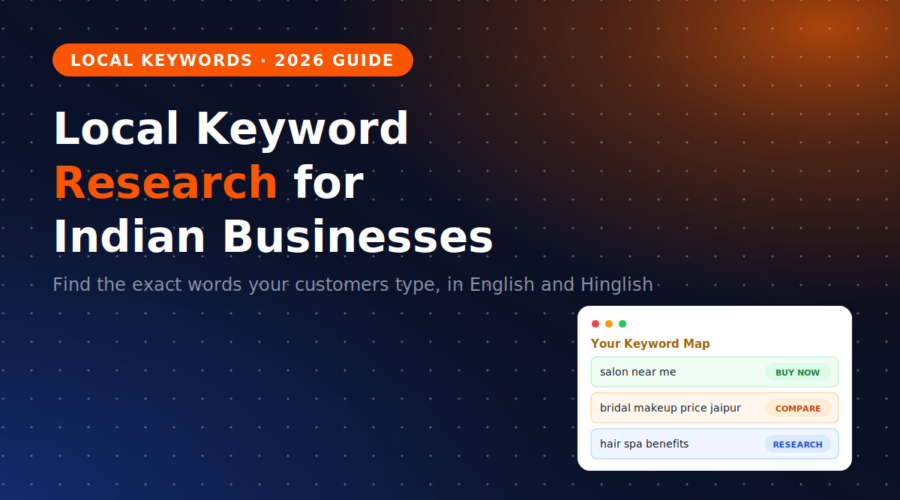
This is the complete, practical guide for Indian businesses: how to find your keywords using free tools, the Hinglish layer most guides ignore, and exactly where each keyword should go once you’ve found it. No paid software required.
📋 Table of Contents
- Why Local Keyword Research Is a Different Game
- The Anatomy of a Local Keyword (Intent Tiers)
- Step 1: Build Your Seed List From Real Customers
- Step 2: Expand It With Free Tools
- Step 3: The Hinglish & Vernacular Layer
- Step 4: Mine Your Competitors
- Step 5: Prioritise by Intent, Not Volume
- Step 6: Map Every Keyword to an Asset
- Step 7: Track Rankings the Honest Way
- The Mistakes That Waste Your Research
- How RankMap Turns Keywords Into Rankings
- FAQ
Why Local Keyword Research Is a Different Game
Regular SEO chases search volume. Local SEO chases intent within a radius, and the numbers show how much of Google that is: 46% of all Google searches have local intent, and Glimpse trend data cited by Shopify’s 2026 report counts over 200 million “near me” searches every month.
Two things make the local version different:
- Volume numbers lie to you. Keyword tools show national volume. “AC repair” might show 90,000 searches, but you only compete for the slice inside your service area. A keyword showing “low volume” nationally can still bring you 15 calls a month locally.
- Google adds the location for the searcher. Someone typing just “dentist” on a phone is treated as “dentist near me.” So your real keyword universe includes implicit local searches, which is why your Google Business Profile fields matter as much as your website (we covered which fields in the complete GBP optimization guide).
The Anatomy of a Local Keyword (Intent Tiers)
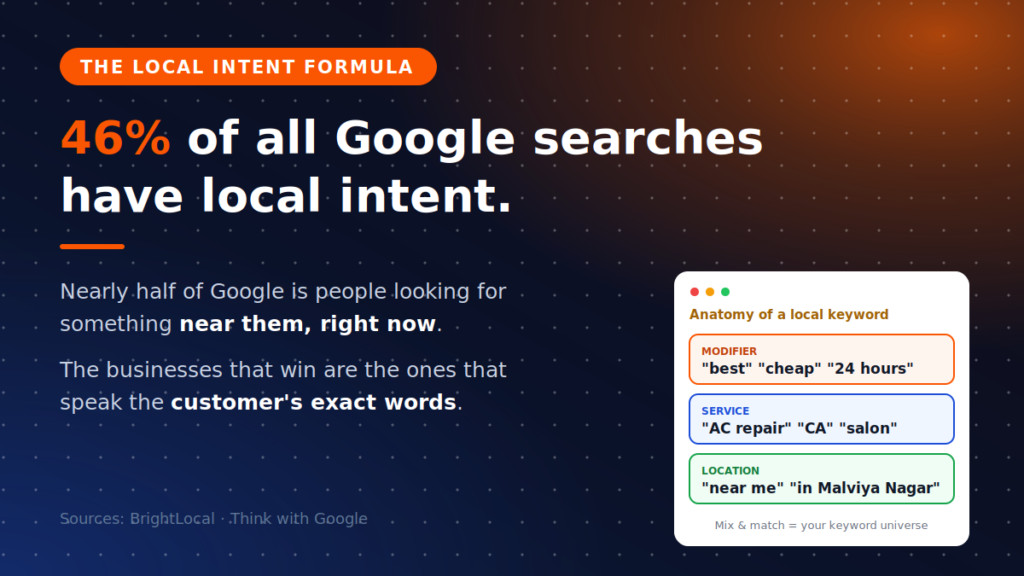
Almost every local keyword is built from three blocks: modifier + service + location. “Best (modifier) salon (service) in Malviya Nagar (location).” Mix and match those blocks and you have your keyword universe. What decides priority is intent:
| Intent Tier | Example Keywords | What They Want |
|---|---|---|
| Buy now | “salon near me”, “emergency plumber jaipur”, “CA near me for GST filing” | A business, today. Highest priority: these searches convert within hours. Remember, 76% of nearby searchers visit within 24 hours. |
| Compare | “bridal makeup price jaipur”, “best tiles shop in vaishali nagar”, “physio charges per session” | Shortlisting 2-3 options. Won by reviews, photos, and prices on your profile. |
| Research | “hair spa benefits”, “root canal vs extraction”, “how to choose CA for startup” | Learning, not buying yet. Blog and post content territory; builds authority and AI citations. |
Step 1: Build Your Seed List From Real Customers
Before touching any tool, capture the language already around you. This is where the physiotherapist story gets fixed:
- Write every service you offer in customer words, not trade words. Not “orthodontic intervention”: “braces for teeth.” Not “MEP contracting”: “electrical work for shops.”
- Scroll your WhatsApp Business chats. The exact phrases in enquiry messages (“bhaiya AC ki servicing kitne ki hogi”) are keywords in their rawest form.
- Read your own Google reviews. Customers describe what they bought in their words: “got my sofa reupholstered”, “quick passport photo”. Each phrase is a keyword candidate.
- Ask your counter staff what customers ask for when they walk in or call. Staff hear the real vocabulary all day.
- List every locality you serve: your area, neighbouring areas, and the colloquial names people actually use (“C-Scheme”, not just the official ward name).
Target: 20-30 seed phrases. Quantity comes next; authenticity comes from here.
Step 2: Expand It With Free Tools
Now multiply those seeds, without spending a rupee:
- Google Autocomplete: type each seed slowly in an incognito window and note every suggestion. Then run the alphabet trick: “salon jaipur a”, “salon jaipur b”… each letter surfaces new phrases.
- People Also Ask boxes: search a seed, expand the PAA questions, and note them. These are your Research-tier keywords and future FAQ content.
- Google Maps search suggest: type your service into Maps itself. Maps autocomplete reflects local search behaviour even better than web search.
- Google Keyword Planner: free with a Google Ads account (no spend needed). Set location to your city for volume ranges that actually mean something locally.
- Google Search Console: if you have a website, the Performance report shows queries you already appear for. Keywords ranking at positions 8-20 are your fastest wins.
- Your GBP Performance tab: shows the actual searches that surfaced your profile. This is gold: real, local, and free.
Dump everything into one spreadsheet column. A typical service business ends up with 100-200 raw keywords. Messy is fine at this stage.
Step 3: The Hinglish & Vernacular Layer
Here’s what international keyword guides completely miss: Indian customers search in mixed language, and those searches are often less competitive.
- Hinglish modifiers: “sasta” (cheap), “accha” (good), “ladies ke liye”, “ghar pe service”. Run your top services through autocomplete with these and watch new suggestions appear.
- Transliterated service words: people type “shaadi ka card printing”, “mehendi artist”, “tiffin service” in Roman script. If you serve these needs, these ARE your keywords.
- Voice search phrasing: a large share of Indian local search is spoken, and spoken queries are longer and more conversational: “sabse accha AC mechanic kaun sa hai yahan”. You capture these with naturally worded GBP descriptions, services, and FAQ content rather than exact-match stuffing.
- The AI layer: with 45% of consumers now asking ChatGPT and similar tools for local recommendations, conversational phrasing matters even more. AI pulls from profiles and reviews that talk the way people ask.
✅ Quick exercise: pick your #1 service and write it four ways: formal English (“air conditioner repair”), casual English (“AC repair”), Hinglish (“AC theek karwana”), and as a spoken question (“AC repair karne wala near me”). Check autocomplete for all four. Most businesses discover an entire keyword set their competitors never optimised for.
Step 4: Mine Your Competitors
Your top-3 Map Pack competitors have already done research, knowingly or not. Reverse-engineer it:
- Their categories: open each competitor’s profile and note primary plus secondary categories. A category they have and you lack is a whole keyword family you’re excluded from.
- Their services and products lists: every listed item is a keyword they’re targeting on-profile.
- Their reviews: the services customers mention repeatedly show what actually drives their business. If every review of a rival salon mentions “keratin treatment” and you offer it too but never mention it, that’s a found keyword.
- Their posts and website page titles: recurring phrases are deliberate targets.
If a competitor consistently outranks you for keywords you’ve both targeted, the gap is usually profile strength and reviews rather than keywords; our Maps troubleshooting guide covers that diagnosis.
Step 5: Prioritise by Intent, Not Volume
Score each keyword in your spreadsheet on three columns, 1-3 each:
- Intent: Buy-now = 3, Compare = 2, Research = 1
- Relevance: core money service = 3, side service = 2, loosely related = 1
- Winnability: weak local competition = 3, moderate = 2, dominated by big brands = 1
Sort by total. Your top 15-20 become your primary keyword set: the ones you optimise for and track monthly. A “boring” 7-point keyword like “washing machine repair malviya nagar” will outearn a glamorous 40,000-volume keyword you’ll never crack, every single month.
Step 6: Map Every Keyword to an Asset
Research only pays when each keyword has a home. Use this placement map:
| Keyword Type | Where It Goes |
|---|---|
| Core service (“AC repair”) | GBP primary/secondary category + services list + website homepage title |
| Buy-now with area (“AC repair malviya nagar”) | GBP description (naturally), website service page, Google Posts |
| Compare (“AC service charges jaipur”) | Services list with prices, FAQ on profile and website |
| Research (“window AC vs split AC”) | Blog posts and Google Posts; feeds AI Overviews citations |
| Hinglish/voice phrases | GBP description and Q&A, review responses, FAQ wording |
| Every keyword’s locality version | Never in your business name (suspension risk); yes in description, posts, and website copy |
One rule ties it together: one primary keyword per asset. A service page targeting five keywords ranks for none of them.
Step 7: Track Rankings the Honest Way
Two tracking traps to avoid. First, Search Console “average position” blends every location and query variation into one misleading number. Second, and worse, searching your own keywords from your shop: proximity bias means you’ll always look like you rank #1 while customers across town see something completely different.
The honest method is geo-grid tracking: your rank for each primary keyword measured from dozens of points across your service area, repeated monthly. It shows keyword performance the way customers actually experience it, neighbourhood by neighbourhood, and tells you exactly where your next optimisation effort should aim.
The Mistakes That Waste Your Research
⚠️ 1. Chasing national volume numbers. Local winnability and intent beat volume every time.
⚠️ 2. Stuffing keywords into your business name. Still the fastest route to a GBP suspension. Keywords live in descriptions, services, and content.
⚠️ 3. Doing the research and never placing the keywords. An unmapped spreadsheet ranks for nothing. Step 6 is the whole point.
⚠️ 4. Ignoring the language your customers actually use. If enquiries come in Hinglish and your profile reads like a corporate brochure, you’ve optimised for the wrong audience.
⚠️ 5. Treating it as one-time work. Seasonal keywords (wedding season, monsoon repairs, Diwali offers) and new services mean a quarterly refresh, minimum.
How RankMap Turns Keywords Into Rankings
Research tells you which battles to fight. RankMap fights them for you: an AI-powered Google Maps ranking platform designed and priced for Indian businesses.
- 📍 Keyword-Level Geo-Grid Tracking — every primary keyword tracked from dozens of points across your city, monthly, so you see exactly which keywords are winning in which neighbourhoods.
- 🔍 AI Profile Optimization — your keywords placed correctly across categories, descriptions, and services, without the stuffing that gets profiles suspended. Explore GBP Management.
- ⭐ Review Keyword Engine — review requests that naturally prompt customers to mention your services and area, turning reviews into ranking assets. Explore Review Management.
- 🔗 Citation Building — consistent listings across 62+ Indian directories so your keyword relevance stands on a trusted foundation. Explore Citations.
- 🦾 AI SEO (GEO-ready) — conversational and Hinglish query coverage for ChatGPT, Gemini and Google AI Mode, where a growing share of local discovery now happens. Explore AI SEO.
- 📊 Plain-Language Reports — weekly progress in English + Hindi: which keywords moved, where, and what we’re doing next.
No agencies. No ₹25,000/month retainers. Check our pricing: plans cost less than one lost customer per month.
FAQ
How many keywords should a local business target?
A focused primary set of 15-20 keywords covering your money services and main localities is plenty for most single-location businesses. Track those monthly. Keep the longer research list as a content bank for posts, FAQs, and blog topics rather than trying to “rank for everything” at once.
Do I need paid tools like Ahrefs or Semrush for local keyword research?
No. For a single-location local business, Google’s own free surfaces (Autocomplete, People Also Ask, Maps suggest, Keyword Planner, Search Console, and your GBP Performance tab) reveal more locally relevant keywords than national tools do. Paid tools become useful for multi-city businesses and content-heavy strategies.
Should I create separate keywords for every locality I serve?
List your genuine service localities and use them naturally in your description, posts, and website copy. But don’t create fake profiles or virtual addresses to “rank” in areas where you have no presence; that’s a suspension risk. For service-area businesses, defined service areas plus locality mentions in content is the safe, effective approach.
How do Hinglish keywords affect my Google Business Profile?
Positively, when used naturally. Google matches transliterated and mixed-language queries against your description, services, Q&A, and review content. Writing the way your customers speak (including common Hinglish phrases for your services) widens the queries you can match without any policy risk, and it feeds AI recommendations the same conversational phrasing users ask with.
Sources & Further Reading
- BrightLocal — Local SEO Statistics 2026
- Shopify — Local SEO Statistics 2026 (Glimpse “near me” trend data)
- BrightLocal — Local Consumer Review Survey 2026
- Google — Keyword Planner (free tool)
- Think with Google — Consumer local search behaviour research
Want results like these for your business?
RankMap's AI manages your GBP, reviews, and citations automatically — so you rank #1 on Google Maps without lifting a finger.