Sit in any market chai break from Jaipur to Coimbatore and you’ll hear the same confident lines: “Humara kaam word of mouth se chalta hai.” “I checked, we’re already #1 on Google.” “Negative review ka reply mat karo, aur attention milega.”
Every one of these sounds reasonable. Every one of them is costing the person saying it real money. And because these beliefs get passed shop-to-shop like trade wisdom, they survive year after year while the businesses holding them quietly lose ground to competitors who know better.
So we’re fact-checking the seven most expensive ones, with data. Fair warning: myth #4 stings almost everyone.
📋 Table of Contents
- Myth #1: “Word of mouth is enough, Google is for big brands”
- Myth #2: “I made my profile once, the work is done”
- Myth #3: “My higher star rating beats their review count”
- Myth #4: “I checked, I already rank #1”
- Myth #5: “Ignore negative reviews, or get them deleted”
- Myth #6: “Adding keywords to my business name boosts ranking”
- Myth #7: “AI chatbots don’t matter for a small local shop”
- The Full Scorecard
- How RankMap Replaces Myths With Measurements
- FAQ
Myth #1: “Word of mouth is enough, Google is for big brands”
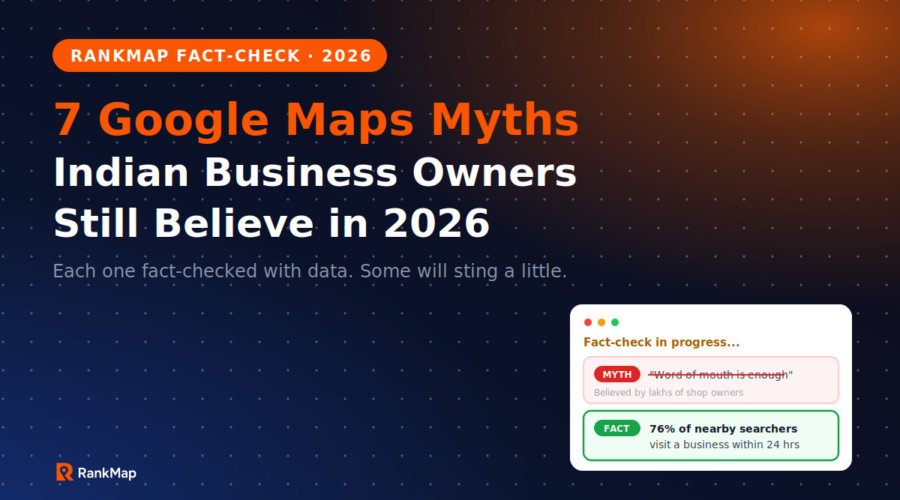
FACT Word of mouth now happens WITH Google, not instead of it. Your friend recommends a shop, and the very next thing you do is search it on Maps to check the rating, photos, and timings before going.
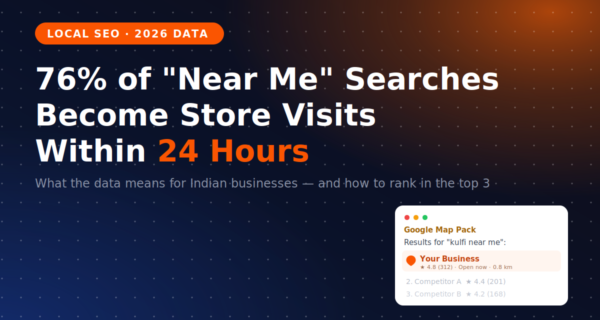
The numbers are blunt: 46% of all Google searches have local intent, and 76% of people who search for something nearby visit a business within 24 hours, with 28% purchasing the same day (Think with Google). Meanwhile 97% of consumers read reviews before choosing a local business. Even your referred customers are checking you online, and if what they find looks abandoned, some of them quietly go elsewhere.
Do instead: treat Google as the front door your word of mouth walks through. The full picture of what’s flowing through that door is in our “near me” searches data report.
Myth #2: “I made my profile once, the work is done”
FACT A profile is a weekly habit, not a form you fill once. Google rewards activity and completeness, and quietly demotes ghosts.
Complete profiles get 7× more clicks and 70% more in-store visits than incomplete ones, and profiles with just up-to-date hours get 2× more visits (Google via Searchlab). Worse, an unmanaged listing drifts: strangers can suggest edits, hours go stale, and 62% of consumers avoid businesses with incorrect info. And if that 2021 profile was never actually verified, it isn’t ranking at all; our verification guide covers that check first.
Do instead: fifteen minutes a week: one post, fresh photos monthly, hours updated every festival. The complete weekly system is in our GBP optimization guide.
Myth #3: “My higher star rating beats their review count”
FACT A 4.9 from 11 reviews loses to a 4.3 from 380 reviews, in rankings and in trust. Volume, velocity, and recency carry the weight.
Businesses with 50+ reviews are 266% more likely to appear in the Local Pack than those under 10, top-3 businesses average around 561 reviews (Semrush), and 73% of consumers only trust reviews from the last month. The kicker from Northwestern’s Spiegel Research Center: a perfect 5.0 is actually trusted less than a 4.5, because readers suspect fake reviews. Your occasional 4-star review is making you look real.
Do instead: build steady weekly review flow with WhatsApp asks at the peak-happiness moment. The exact scripts are in our reviews playbook.
Myth #4: “I checked, I already rank #1”
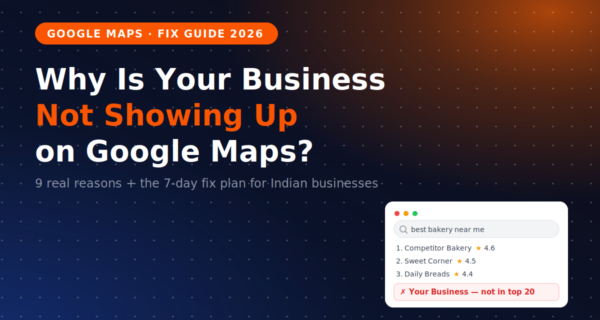
FACT You searched from your own shop. Distance is a top-3 ranking factor, so Google shows YOU your business first. Customers 3 km away may see you at #15, or not at all.
This is the myth that fools the most owners, including sharp ones, because the evidence is right there on their own phone. But per Whitespark’s local ranking factor research, proximity to the searcher heavily shapes every result. Standing at your counter, you are the closest possible searcher to your own business. That #1 is real for exactly one location on earth: your shop.
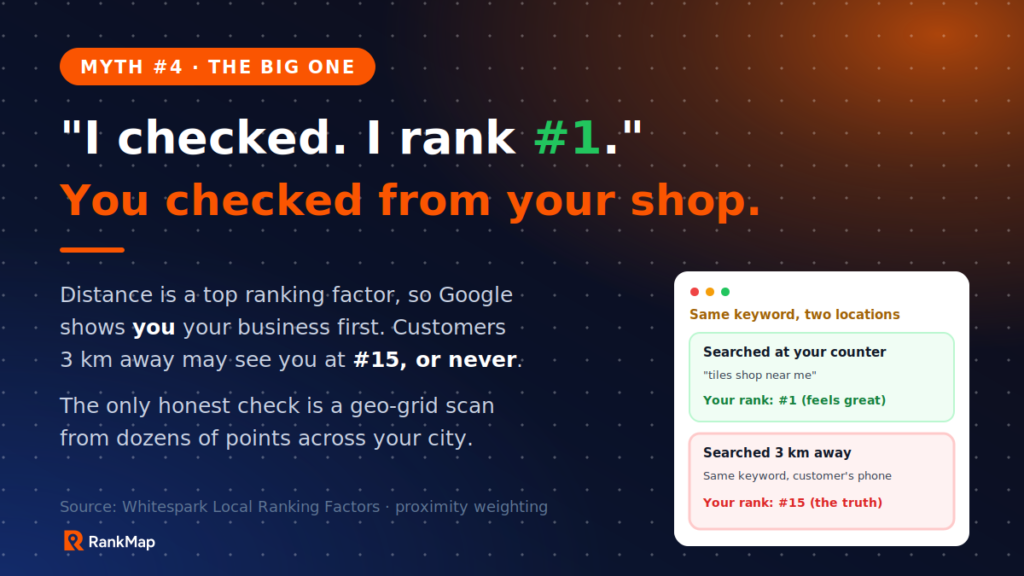
Do instead: measure from where customers actually stand: a geo-grid scan checks your rank from dozens of points across your city. If the map comes back redder than expected, our Maps troubleshooting guide walks the nine likely reasons in order.
Myth #5: “Ignore negative reviews, or get them deleted”
FACT Silence is what readers punish. 88% of consumers favour businesses that respond to all reviews, and 45% are MORE likely to visit after seeing a thoughtful response to a negative one.
Only 36% of businesses respond at all (Searchlab 2026), which makes responding one of the cheapest advantages left. As for deletion: no one can “delete” a Google review for money; genuine reviews stay, and only policy-violating ones can be removed via Google’s own reporting flow. Anyone selling guaranteed removal is selling you a scam, sometimes one that gets your profile in trouble.
Do instead: acknowledge, own what’s genuine, fix it, and take it offline; 25+ ready templates including Hinglish versions are in our review response guide.
Myth #6: “Adding keywords to my business name boosts ranking”
FACT This one is dangerous BECAUSE it sometimes works, briefly. It violates Google’s naming policy, and enforcement in 2026 means suspension: your profile, reviews, and years of work offline while you appeal.
Google requires your profile name to match your real-world signboard. Keyword-stuffed names are among the leading causes of both failed verifications and sudden suspensions, and a name mismatch across directories also wrecks the NAP consistency that citations depend on (the trust mechanics are in our local citations guide).
Do instead: keywords belong in your description, services list, posts, and website. Same benefit, zero suspension risk. Where each keyword goes is mapped field-by-field in our local keyword research guide.
Myth #7: “AI chatbots don’t matter for a small local shop”
FACT 45% of consumers now use ChatGPT or similar AI tools for local business recommendations, up from just 6% a year earlier. And roughly 40% of local Google queries trigger AI Overviews that summarise your profile before anyone sees your listing.
That’s BrightLocal’s 2026 consumer survey, and the shift is fastest among exactly the customers with money to spend. AI systems recommend businesses with complete structured profiles, consistent citations, and detailed reviews. In other words: everything in the six myths above now decides your AI visibility too. Small shops that fix this early get recommended while competitors are still calling it a fad.
Do instead: make your profile, reviews, and website AI-readable. That layer is exactly what our AI SEO service handles.
The Full Scorecard
| The Belief | Verdict | The Number That Kills It |
|---|---|---|
| “Word of mouth is enough” | MYTH | 76% of nearby searchers visit within 24 hours |
| “Profile once made = done” | MYTH | Complete profiles get 7× more clicks |
| “High rating beats review count” | MYTH | 50+ reviews = 266% more Local Pack visibility |
| “I checked, I rank #1” | MYTH | Proximity bias: #1 at your counter, #15 across town |
| “Ignore or delete negative reviews” | MYTH | 88% choose businesses that respond to all reviews |
| “Keywords in the name boost ranking” | RISKY | Leading cause of profile suspensions in 2026 |
| “AI doesn’t matter for small shops” | MYTH | 45% of consumers now ask AI for local recommendations |
How RankMap Replaces Myths With Measurements
Every myth above survives for the same reason: the owner has no honest data, so trade gossip fills the gap. RankMap replaces the gossip with numbers: an AI-powered Google Maps ranking platform designed and priced for Indian businesses.
- 📍 Geo-Grid Heatmap Scans — the myth #4 killer. See your real rank from dozens of points across your city for every keyword, updated monthly. No more #1 illusions.
- 🔍 40-Point AI Profile Audit — completeness, categories, name-policy risks, and every “set and forget” gap flagged in plain language. Explore GBP Management.
- ⭐ Review Velocity Engine — automated WhatsApp/SMS requests plus AI-drafted responses in English and Hindi, so myths #3 and #5 never cost you again. Explore Review Management.
- 🔗 Citation Consistency — your exact NAP across 62+ Indian directories, keeping Google’s trust intact. Explore Citations.
- 🦾 AI Visibility (GEO-ready) — structured for ChatGPT, Gemini and Google AI Mode, so myth #7 becomes your head start. Explore AI SEO.
- 📊 Reports in Plain Language — weekly progress in English + Hindi. What moved, where, and why.
No agencies. No ₹25,000/month retainers. Check our pricing: plans cost less than one lost customer per month.
FAQ
Which of these myths costs businesses the most money?
Myth #4, by a distance. Believing you rank #1 removes all urgency to improve, so the business does nothing while competitors climb. Myths #1 and #3 cost steadily too, but #4 is the one that actively blocks the fix, because the owner has “seen the proof” on their own phone. One geo-grid scan usually ends the debate in thirty seconds.
My cousin’s shop really did rank higher after adding keywords to the name. Why?
Because it can work, temporarily, which is exactly what makes it dangerous. Google’s enforcement runs in waves: profiles violating the naming policy may rank for weeks or months before a suspension lands, taking the reviews and history with it. The gain is borrowed, the penalty is real, and reinstatement appeals take far longer than the boost lasted.
I believed several of these. Where do I start fixing things?
In this order: verify the profile if it isn’t (nothing works before that), complete every profile field, start a weekly review-request habit, then respond to your review backlog. That sequence follows our verification guide, GBP optimization guide, and reviews playbook, all linked above. Most businesses doing these consistently see Map Pack movement within 30-90 days.
Is Justdial still relevant, or is that a myth too?
Justdial still matters, but its role has changed: it’s now most valuable as a high-authority citation and a page-one presence for your brand name, rather than your main discovery channel. Google Maps is where the “near me” discovery volume lives. Keep your Justdial listing accurate and consistent with your Google profile (our citations guide covers the how), but invest your weekly effort where the searches are.
Sources & Further Reading
- BrightLocal — Local SEO Statistics 2026
- BrightLocal — Local Consumer Review Survey 2026
- Searchlab — Google Business Profile Statistics 2026
- Think with Google — Consumer local search behaviour research
- Wiser Review — Google Review Statistics 2026 (recency data)
Want results like these for your business?
RankMap's AI manages your GBP, reviews, and citations automatically — so you rank #1 on Google Maps without lifting a finger.